Own your compliance data: the case for in-country screening
Ask a compliance team where their customers' most sensitive data lives, and increasingly the honest answer is: "in a vendor's cloud, in another country." Names, national IDs, dates of birth, risk ratings, adverse findings — the entire due-diligence file —…
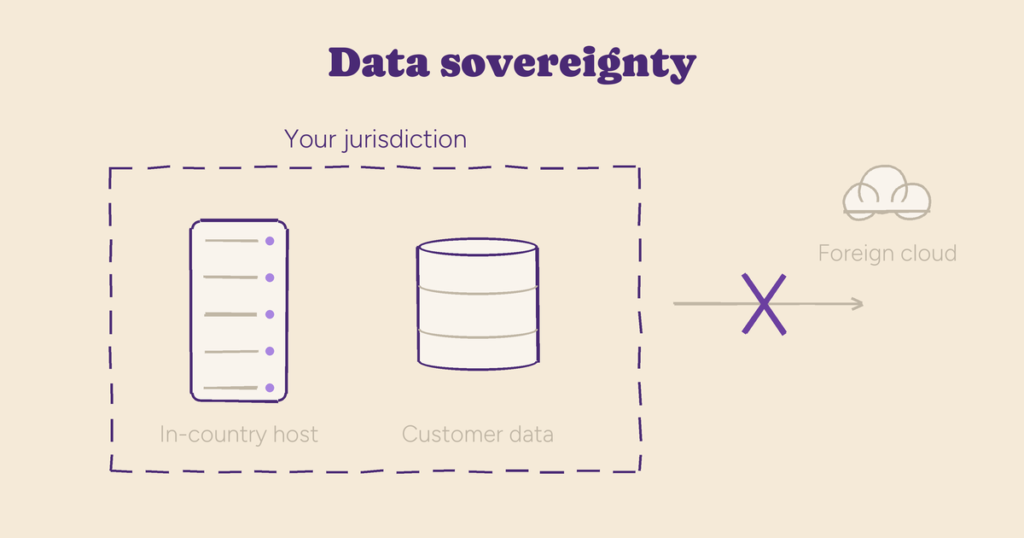
Ask a compliance team where their customers’ most sensitive data lives, and increasingly the honest answer is: “in a vendor’s cloud, in another country.” Names, national IDs, dates of birth, risk ratings, adverse findings — the entire due-diligence file — sitting in a global, multi-tenant SaaS platform, subject to that provider’s jurisdiction, retention and access model.
For a growing number of institutions, that’s no longer acceptable.
Data residency stopped being optional
Regulators and data-protection regimes increasingly expect personal and financial data to stay in country, or at least stay under the institution’s direct control. Banking secrecy laws, sector guidance, and national data-protection acts all point the same way. A global cloud screening tool — however good — forces a choice between the tool and the mandate.
Cloud SaaS also concentrates risk you don’t control: an outage, a breach, a policy change or a price hike at the vendor becomes your compliance incident, on someone else’s timeline.
Cloud convenience without the cross-border trade-off
The reflex is that keeping data in-country means going backwards to something old and clunky. It doesn’t. A modern platform can be delivered as an in-country cloud service — the polish and elasticity of a modern web application, hosted in a cloud region inside your own jurisdiction rather than a foreign, multi-tenant one.
SonarPulse runs where your regulator wants it. Customer PII, screening results and risk records stay in your jurisdiction, behind your access controls. Your data-protection officer can answer the residency question with one word: here. (For institutions with a hard mandate, the same platform can also be deployed in a private data centre or on-premises — but the default is a sovereign, in-country cloud.)
Control extends beyond location
Owning where the data lives also means owning the decisions:
– Risk scoring is yours to tune. Weights and thresholds are configured per tenant and business line — a transparent, auditable model, not a vendor black box. – Sources are yours to choose. Official regulator lists, open datasets, court/enforcement records, local press and a localised PEP database — aggregated, not rented from a single feed. – Tenancy is yours to segment. Multi-tenant / business-unit isolation with role-based access, so each team sees only its own customers.
Predictable cost, not a growth tax
There’s a commercial dividend too. Global cloud and premium-data pricing scales with volume — every customer and every re-screen adds cost. A flexible-pricing model turns compliance into a fixed capability you own, not a meter that runs faster as you grow.
The bottom line
Global cloud SaaS asked institutions to trade control for convenience. For regulated firms with data-sovereignty obligations, that trade no longer clears — and it no longer has to.
You wouldn’t outsource your core banking ledger to a black box in another country. Your customers’ due-diligence file deserves the same standard.
SonarPulse is delivered as an in-country cloud platform (private-data-centre or on-premises where mandated), with a compliance workflow and risk engine you fully control. Request a compliance health check.